car accident Claims
35+ Calgary Traffic Incident and Accident Statistics: Trends, Hotspots, and What the Numbers Show

Book a FREE Call
Tell us what happened
Let us help.
Table of Contents

Published: May 19, 2026 | Last Reviewed: May 19, 2026
Every day, Calgary drivers, passengers, and road users are involved in traffic incidents that range from minor collisions to life-altering crashes. Some happen during the morning commute, while others take place at intersections most Calgarians pass through without a second thought.
Most people assume they know when and where car accidents happen. They avoid driving late at night, assume weekends are more dangerous than weekdays, and think of winter as the obvious high-risk season.
The data tells a more complicated story.
To find out what is actually happening on Calgary roads, we analyzed traffic incident records from the City of Calgary, spanning January 2023 to March 2026.
We looked at the data from more than 27,000 recorded incidents across the timespan, broken down by location, date, time, and city quadrant.
Here is what the data shows about when and where traffic incidents happen, and what it means for anyone who drives in this city.
Calgary Traffic Incidents Are Rising Year Over Year
Calgary’s roads have become measurably busier over the past four years, as expected, given that the population has grown by 15% during the same period.
Tracked traffic incidents have climbed year over year, and the pace of that increase shows no sign of slowing. 2024 stands as the peak year on record for traffic incidents, but the first quarter of 2026 suggests it may not hold that position for long.
The rise in incidents has also coincided with a surge in public interest. Google Trends data shows that Albertans are searching for information about car accidents at a higher rate than at any point in the past three years, reaching a score of 85 out of 100 in 2026.
That is not a coincidence. When roads become more dangerous, people start looking for answers.
- Q1 2026 is the highest January-to-March total on record at 1,716 incidents, more than any Q1 in 2023, 2024, or 2025.
- Calgary recorded 6,425 tracked traffic incidents in 2024, the highest annual total in the dataset and an increase from 6,123 in 2023.
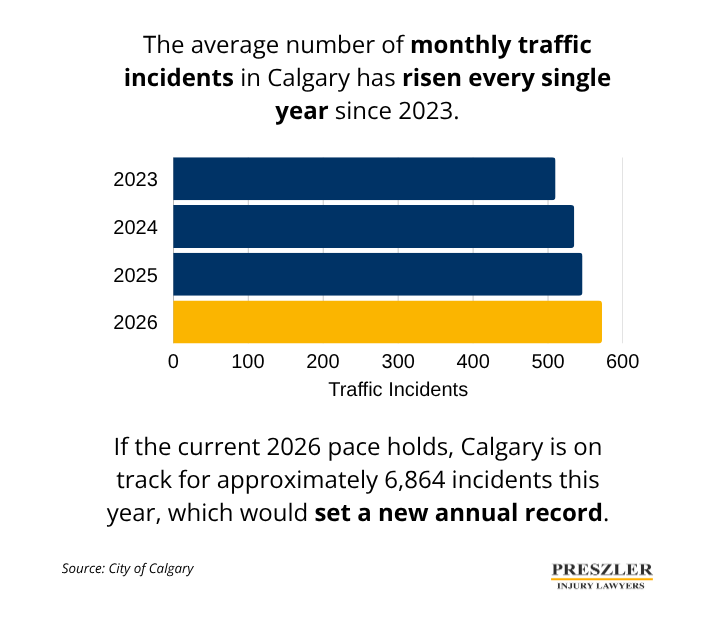
- The average number of monthly incidents has risen every single year, from 510 in 2023 to 572 through Q1 2026.
- If the current 2026 pace holds, Calgary is on track for approximately 6,864 incidents this year, which would set a new annual record.
- Albertans are searching for information about car accidents at the highest rate ever recorded, with Google Trends reaching 80.7 out of 100 in 2026, up from 58.1 just five years earlier.
Which Parts of Calgary Have the Most Traffic Incidents?
Not all parts of Calgary carry equal risk. When traffic incident data is broken down by city quadrant, a clear and consistent pattern emerges across every year in the dataset.
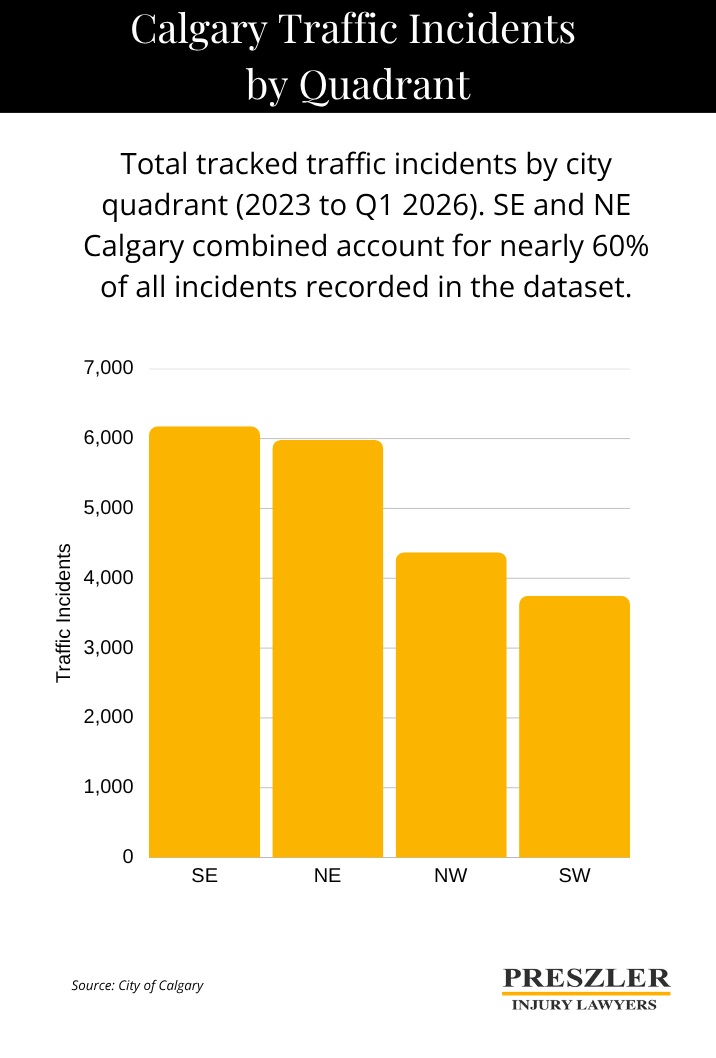
SE Calgary has ranked first for total incidents in every single year analyzed, accounting for roughly 30% of all tracked incidents despite being one of four quadrants. NE Calgary is a close second, and together, the two eastern quadrants account for nearly 60% of all tracked incidents in the city.
The sharpest contrast is between the two extremes. SE Calgary recorded 65% more incidents than SW Calgary across all years combined, a difference of more than 2,400 incidents.
The SE quadrant also leads when looking specifically at multi-vehicle incidents, the collision type most likely to involve serious injury and legal consequences. SE has recorded the highest number of multi-vehicle incidents in every single year in the dataset. For two-vehicle incidents, the picture is more nuanced. SE led in 2023, but NE overtook it in both 2024 and 2025 before SE reclaimed the lead in Q1 2026, suggesting the northeast is becoming an increasingly high-risk area for this type of collision.
- SE Calgary is the most dangerous quadrant in every single year in the dataset, 2023, 2024, 2025, and Q1 2026, without exception.
- SE accounts for roughly 30% of all Calgary traffic incidents in every year analyzed.
- SE recorded 6,167 total incidents across all years combined, compared to SW’s 3,748, a difference of 65%.
- SW Calgary is the safest quadrant by total incidents across every year in the dataset.
- NE Calgary ranks second overall with 5,980 combined incidents, ahead of NW (4,374) and SW (3,748).
- SE Calgary leads every year for multi-vehicle incidents: 214 (2023), 197 (2024), 148 (2025), and 61 through Q1 2026.
- Multi-vehicle incidents as a share of SE’s total declined from 11.2% in 2023 to 8.4% in 2025, before spiking back to 11.1% in Q1 2026.
- SE led two-vehicle incidents in 2023 with 387, but NE overtook it in both 2024 (300 vs 262) and 2025 (276 vs 231).
- SE reclaimed the top spot for two-vehicle incidents in Q1 2026 with 138 versus NE’s 102.
- NE Calgary has emerged as the most dangerous quadrant specifically for two-vehicle collisions over the past two years, a shift that was not visible in the 2023 data.
The Most and Least Dangerous Months to Drive in Calgary
When you drive in Calgary matters almost as much as where. Overall, traffic incidents peak in fall and winter, with October, November, and December consistently recording the highest totals across all years analyzed.
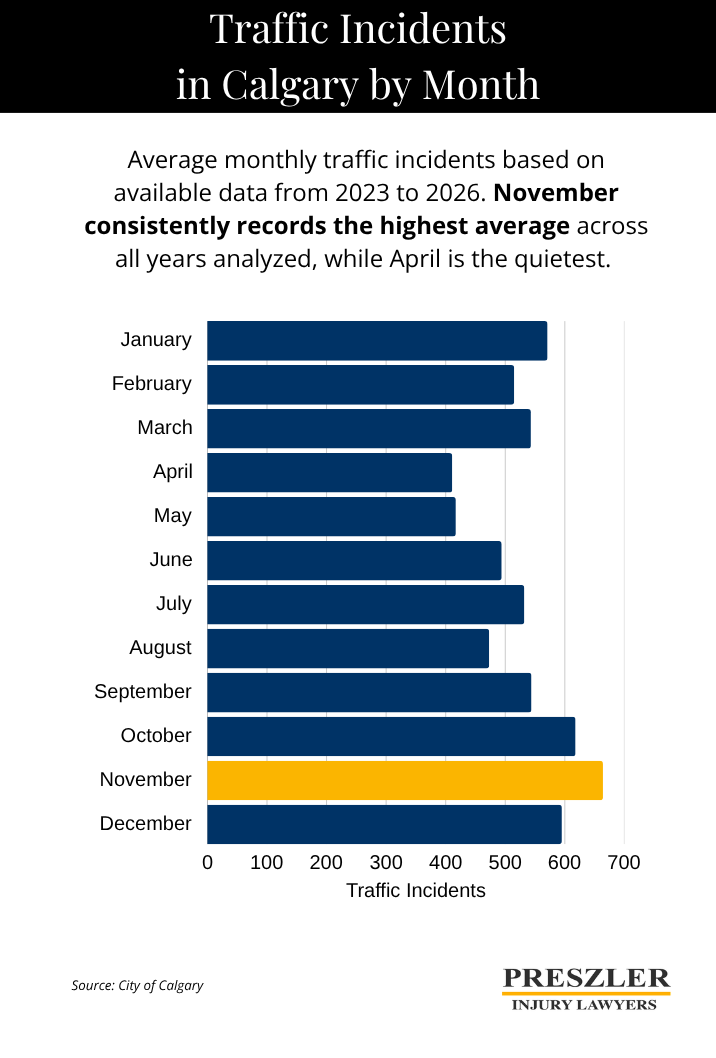
November stands out as the single busiest month on average, with 664 incidents, pointing to a combination of shorter days, deteriorating road conditions, and heavier traffic volumes as the year winds down.
April is consistently the quietest month, closely followed by May. April averages just 411 incidents, the lowest of any month in the dataset.
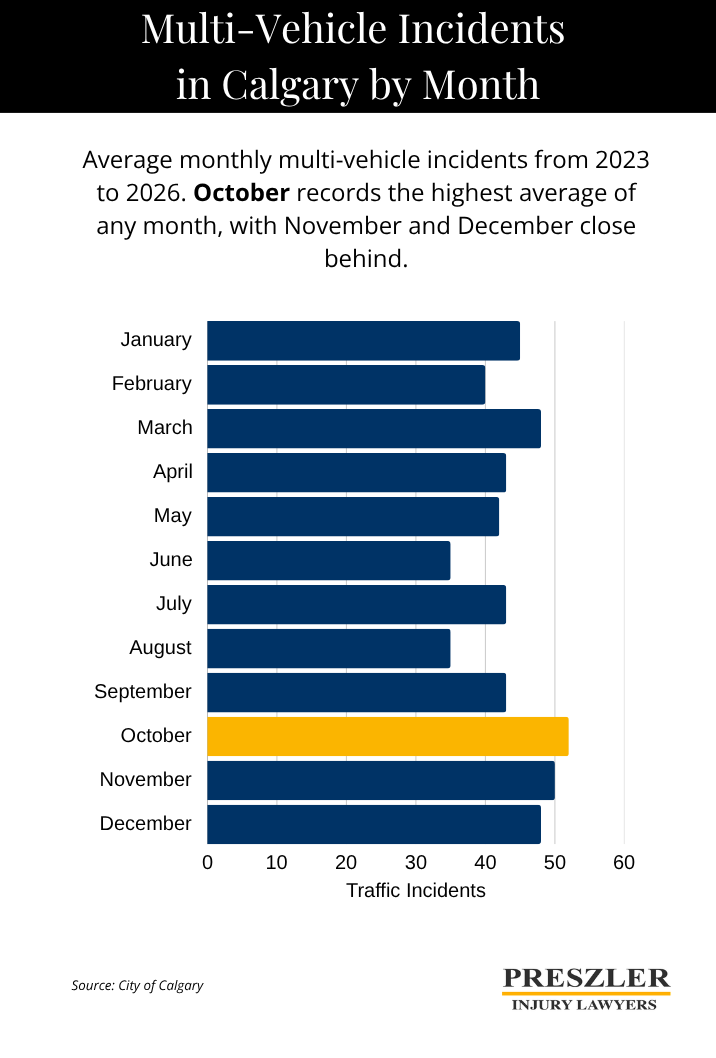
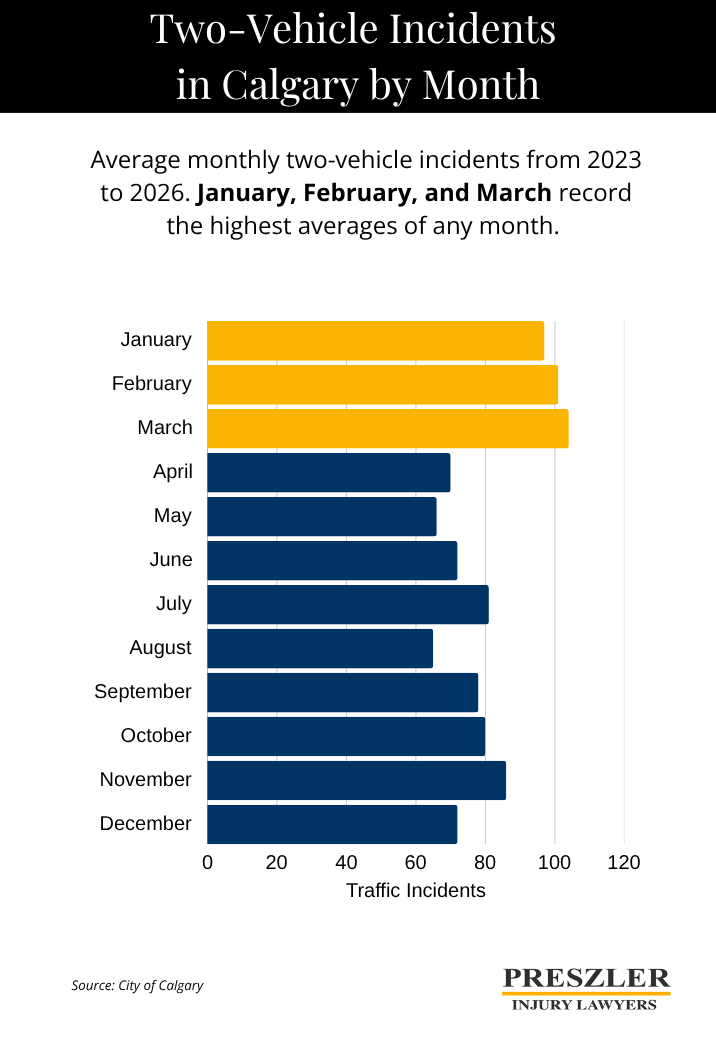
The picture shifts when looking specifically at multi-vehicle and two-vehicle incidents. For multi-vehicle collisions, October averages the highest of any month at 52, with November and December close behind. However, for two-vehicle incidents, the pattern is different. January, February, and March are the three busiest months on average, suggesting that winter road conditions play a more direct role in two-vehicle collisions than in overall incident volume. March 2026 recorded 139 two-vehicle incidents, the highest single month for that category in the dataset.
- November is the single busiest month on average for total incidents at 664, followed by October (618) and December (595).
- April is the quietest month on average, with 411 incidents, the lowest of any month in the dataset.
- No year in the dataset has produced its busiest overall month outside of the October to December window.
- The busiest single month in each full year: October 2023 (674 incidents), November 2024 (740), December 2025 (737).
- October averages the most multi-vehicle incidents of any month (52), with November (49.7) and December (48.0) close behind.
- Two-vehicle incidents peak in Q1. January, February, and March are the three busiest months on average, averaging 97, 101, and 104, respectively.
- March 2026 recorded 139 two-vehicle incidents, the highest single month for that category in the dataset.
The Most Dangerous Day to Drive in Calgary Is Not What You Think
Ask most Calgary drivers which day of the week they would least want to be on the road, and the answer is almost always Friday.
The data suggests they are not entirely wrong.
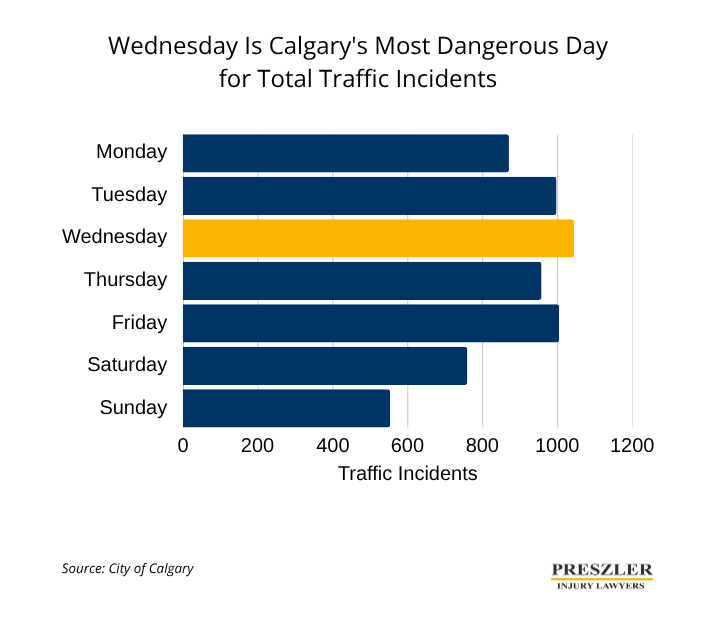
Friday leads for both multi-vehicle and two-vehicle incidents on average. But for total incident volume, the most dangerous day is actually Wednesday, though the margin is closer than you might expect, with just 40 incidents separating the two on average. What is consistent across every year in the dataset is that both days carry significantly more risk than any other.
Sunday is the safest day on Calgary roads by a wide margin.
The contrast between weekdays and weekends is stark across every year analyzed, with weekdays consistently recording higher totals across all three incident categories.
- Wednesday is the most dangerous day for total incidents, averaging 1,044 per year across 2023 to 2025, ahead of Friday (1,004) and Tuesday (997).
- Wednesday averages nearly twice as many total incidents as Sunday (1,044 vs 553).
- Friday is the most dangerous day for multi-vehicle incidents, averaging 92 per year, ahead of Wednesday (86) and Thursday (77).
- Friday also leads for two-vehicle incidents, averaging 155 per year, ahead of Wednesday (150) and Thursday (149).
- Sunday is the safest day on Calgary roads, averaging 553 total incidents per year, the lowest of any day in the dataset.
- Saturday averages 759 incidents per year, making weekends significantly safer than any weekday across all three incident categories.
When Are Calgary Roads Most Dangerous?
The assumption behind this question is that late-night driving is the time when Calgary’s roads are most dangerous. The Calgary data does not support that picture.
The most dangerous time to be on the road in this city is not after midnight. It is the late afternoon, when roads are at their most congested.
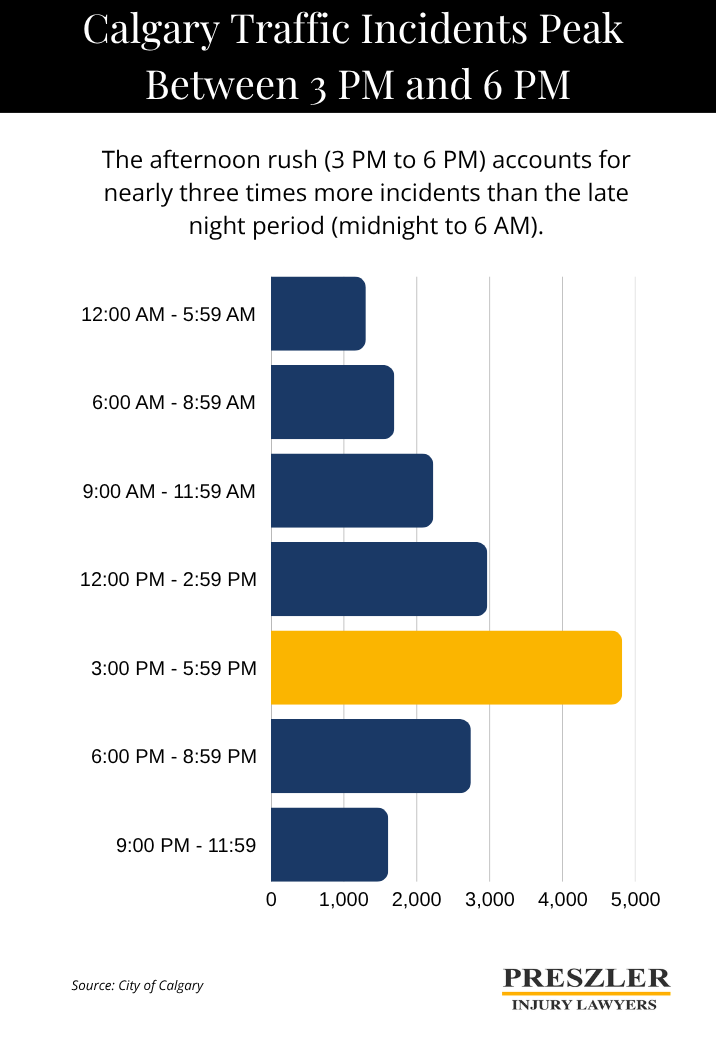
5 PM is the single most dangerous hour of the day. The broader evening rush window from 3 PM to 6 PM accounts for more than one in four of all daily incidents recorded across three years. The morning rush is the second most dangerous window, with 7 AM and 8 AM both recording significant totals. The early hours of the morning are by far the safest time to be on Calgary roads.
- 5 PM is the single most dangerous hour of the day, with 1,722 incidents across 2023 to 2025.
- The evening rush (3 PM to 6 PM) accounts for 26% of all daily incidents.
- There are 9 times more incidents at 5 PM than at 3 AM, the safest hour of the day.
- The morning rush (7 AM to 8 AM) is the second most dangerous window, with 1,032 and 1,080 incidents, respectively.
What Types of Traffic Incidents Happen Most in Calgary?
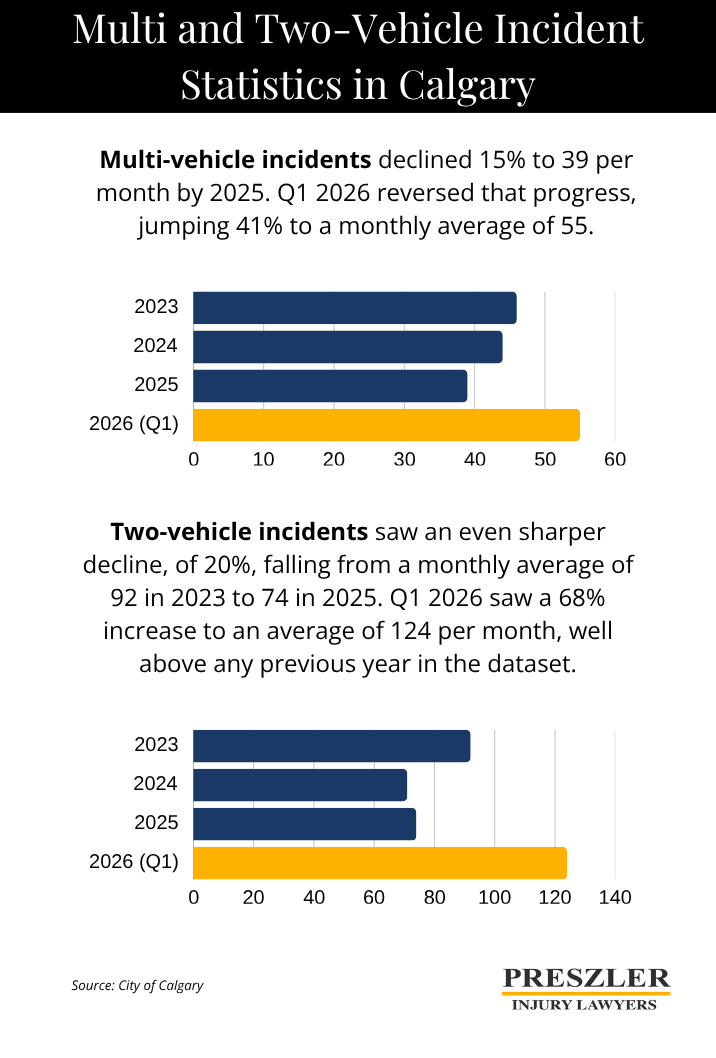
While overall traffic incidents have climbed year over year, not all collision types have moved in the same direction. Between 2023 and 2025, the two most serious categories, multi-vehicle and two-vehicle incidents, both declined meaningfully, even as general traffic incidents increased.
However, the concern for the City of Calgary must be that Q1 2026 has reversed that trend.
Whether that reflects seasonal road conditions during a particularly difficult winter quarter or signals something more persistent will become clearer as more 2026 data becomes available.
- General traffic incidents have grown as a share of total, rising from 73% in 2023 to 79% in 2025, reflecting an overall increase in lower-complexity incidents.
- Two-vehicle incidents fell 26% from 2023 to 2025, dropping from 1,103 to 817, a meaningful reduction in one of the more serious collision categories.
- Multi-vehicle incidents also declined 22% from 2023 to 2025, falling from 548 to 429.
- The monthly average for multi-vehicle incidents declined from 46 per month in 2023 to 39 in 2025, before jumping to 55 per month in Q1 2026, the highest monthly average in the dataset.
- The monthly average for two-vehicle incidents tells the same story, falling from 92 per month in 2023 to 74 in 2025, before surging to 124 per month in Q1 2026, also the highest in the dataset.
What This Means for Albertans Involved in a Traffic Incident
Over three years of Calgary Police data show a city where traffic incidents are not declining.
The overall volume is rising, Q1 2026 is the highest on record, and certain parts of the city and certain times of day carry a disproportionate share of the risk.
Behind every statistic in this dataset is a real person. There’s a driver dealing with the aftermath of a collision, a passenger injured at an intersection they pass through every day, a family navigating consequences they did not see coming. At the same time, Alberta’s auto insurance system is changing.
In 2027, the province is set to introduce its enhanced care model, which will alter what injured drivers and passengers can claim following a collision.
The intent is to streamline compensation and reduce litigation, but the traffic incident data shows that collisions on Calgary roads are not becoming less frequent.
As the system changes, knowing what you’re entitled to recover now and what may change going forward under the new insurance model has never been more important. Jeffrey Preszler, a personal injury lawyer at Preszler Injury Lawyers, believes Albertans must stay alert and informed about their rights going into 2027:
“Alberta’s Bill 47, which is set to take effect on January 1, 2027, is an alarming rollback of individual rights in Alberta and will be devastating to car accident victims. Under the guise of a “care-first” system, the UCP government has stripped Albertans of their fundamental right to seek justice in a court of law. The loudest cheerleaders are the very insurance companies that will profit when your claim disappears. The provincial government should protect individual rights from powerful institutions, not hand those institutions exactly what they asked for on the backs of crash victims. This is not care-first. It is profit-first, and Albertans deserve far better.”
Preszler Injury Lawyers has represented injured Canadians for decades.
If you or someone you know has been involved in a traffic incident in Calgary or elsewhere in Alberta, our team can help you understand your legal options.
Contact Preszler Injury Lawyers online today, or call us at 1-888-494-7191 for a free consultation.
Authored by Preszler Injury Lawyers
Personal Injury Law Firm
Preszler Injury Lawyers represents injured people across Ontario in personal injury matters, including motor vehicle accident claims, slip and fall claims, long-term disability claims, and institutional abuse claims.
More car accident Topics
Here’s more information on car accident related topics that we think you might find helpful.
car accident
|
July 30, 2026
Choosing The Best Car Accident Law Firm In Alberta Starts With Asking Better Questions
Car accidents are an unfortunate reality across Alberta. In Calgary alone, Q1 2026 has already set a new January-to-March high at 1,716 incidents, and if…
car accident
|
June 16, 2026
Direct Compensation For Property Damage (DCPD) in Alberta: Who Pays For Your Car After a Crash?
Unlike how car accident claims work in Alberta currently, the Direct Compensation for Property Damage (DCPD) is a mandatory auto insurance system that was set…
car accident
|
June 12, 2026
Debunking Common Myths About Car Accident Claims in Alberta
After a car accident, the decisions you make in the days and weeks that follow can directly affect the compensation you receive. Misinformation from friends,…
Speak With Our
Legal Team for FREE
Find Out if You Have a Case in Under 5 Minutes
Speak to a Lawyer Now!
We’re here to help.