uncategorized Claims
Dog Bite Claims in Alberta: What You Need to Know

Book a FREE Call
Tell us what happened
Let us help.
Table of Contents

Published: June 12, 2026 | Last Reviewed: June 12, 2026
A dog bite or dog attack can leave lasting physical and emotional damage. Beyond the immediate injury, victims often face medical bills, time off work, and in serious cases, permanent scarring or psychological trauma.
If you or a family member has been injured by a dog in Alberta, you may be entitled to compensation. A dog bite claim is a civil legal action brought against the owner or keeper of a dog that caused injury. These claims can arise from an actual bite or from an attack where no bite occurred but the victim was still harmed.
Alberta law places responsibility on dog owners to control their animals. When they fail to do so, injured victims have legal options.
In this article, we explain how dog bite claims work in Alberta, including the laws that apply, how liability is established, and what compensation may be available.

Dog Bite vs. Dog Attack: What Is the Difference?
First, it helps to understand the difference between a dog bite and a dog attack. These two terms are often used interchangeably, but they describe different types of incidents and can affect how a claim is assessed.
A dog bite involves direct contact where the dog’s teeth break the skin, resulting in a puncture or flesh wound. A dog attack is broader. It includes situations where a dog lunges at or charges a person, causing them to fall and injure themselves, even if no bite occurs.
Both can form the basis of a legal claim in Alberta. The difference between them is important because the nature of the incident influences the type and severity of injuries involved, which in turn affects the compensation available.
Understanding which type of incident occurred is just the first step. The next question is how Alberta law decides who is responsible, and that’s where the province’s legal framework for dog bite claims comes in.
Alberta’s Dog Bite Laws
Alberta does not have a strict liability statute like Ontario’s Dog Owners’ Liability Act, which automatically holds owners responsible regardless of prior knowledge. Instead, the legal framework for dog bite claims in Alberta is built on a combination of provincial legislation, municipal bylaws, and common law.
Alberta’s Dangerous Dogs Act allows a judge to order a dog destroyed if it has bitten or attempted to bite a person, or if it is dangerous and not under proper control. The court may also impose conditions such as keeping the dog muzzled in public, along with fines for noncompliance. However, these orders do not compensate injured victims for their financial or non-financial losses.
Municipal bylaws also apply. In Calgary, dogs must be licensed by three months of age and kept on a leash in public, except on private property or in designated off-leash areas. On pathways, the leash must be no longer than two meters, and dogs must remain under control at all times. Calgary also prohibits dogs from certain areas, including school grounds, playgrounds, sports fields, golf courses, cemeteries, and wading or swimming areas.
Edmonton also has animal licensing and control rules that require dogs to be kept under responsible public control and provide for fines when owners do not comply. While a bylaw breach does not itself establish compensation for an injured person, it may be relevant evidence in a civil claim because it can help show that the owner failed to comply with safety requirements.
Where an attack occurs on private property, victims may have grounds for a claim under Alberta’s Occupiers’ Liability Act, which requires property occupiers to take reasonable care to ensure visitors are reasonably safe. Civil compensation for dog bite injuries in Alberta is pursued through common law via the doctrines of scienter and negligence, which we will explain next.
How Liability Is Proven in Alberta Dog Bite Claims
Civil compensation for dog bite injuries in Alberta is generally pursued through two common law doctrines: scienter and negligence.
Under scienter, a victim may recover damages if they can prove that the owner knew the dog had a propensity to cause the type of harm that occurred. Prior biting is not always required; evidence of aggressive behaviour, lunging, snapping, or similar incidents can be relevant if it shows the owner was aware of the risk.
A dog bite claim may also be brought in negligence. In that case, the focus is on whether the owner knew or ought to have known the dog posed a risk of injury and failed to take reasonable steps to prevent the attack.
Relevant factors can include whether the dog was off‑leash in a public area, whether the owner breached a municipal bylaw, or whether the dog was left unsupervised in a situation where an attack was foreseeable. If the injured person provoked the dog or otherwise contributed to the incident, Alberta courts may reduce the amount of compensation under contributory negligence principles.
Once liability is established, the next question is what compensation an injured victim can recover.
What Compensation Is Available After a Dog Bite in Alberta?
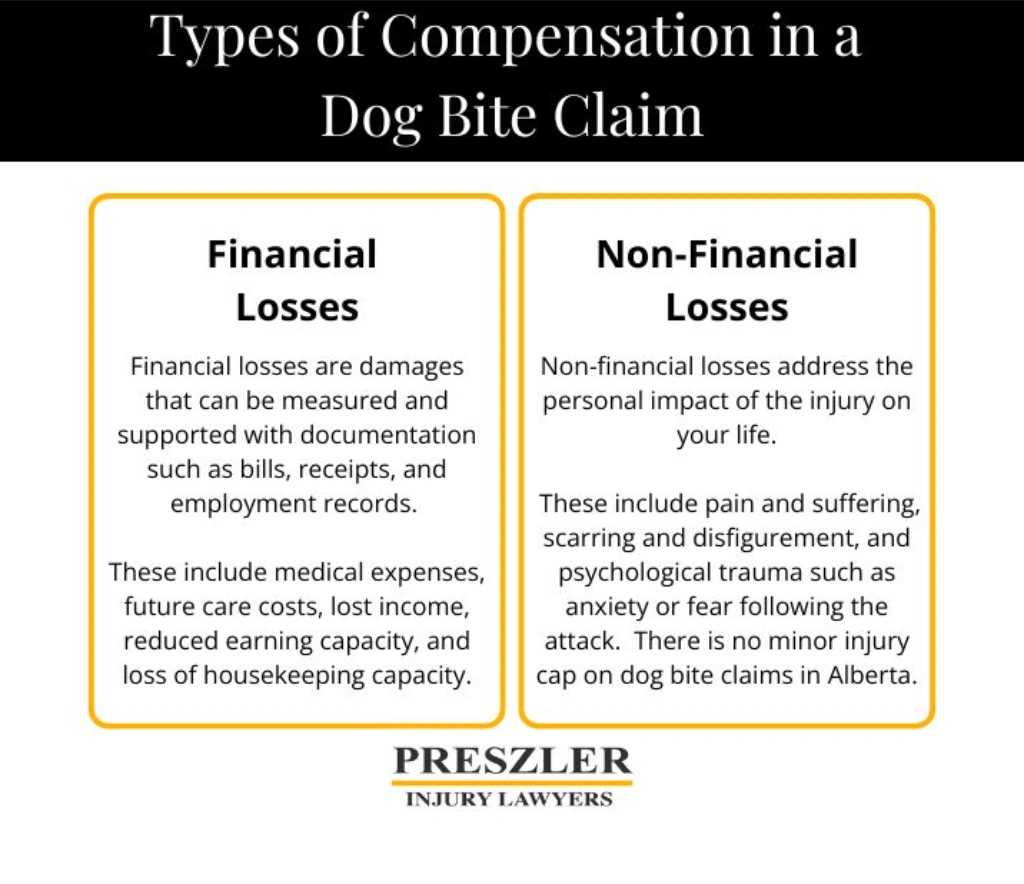
The types of compensation available depend on the nature and severity of the injuries sustained. Dog bite claims in Alberta are not subject to a minor injury cap, meaning victims can pursue full compensation regardless of how injuries are initially categorized.
Compensation in a dog bite claim can include:
- Pain and suffering
- Scarring and disfigurement
- Medical expenses
- Future care costs
- Lost income and reduced earning capacity
- Loss of housekeeping capacity
In fatal cases, families may also pursue compensation for loss of guidance, care, and companionship, as well as funeral expenses. Preszler Injury Lawyers has represented Canadian families in dog attack cases since 1959, including tragic incidents such as the death of an 11‑year‑old boy in Edmonton that involved two dogs.
Even relatively minor injuries can form the basis of a valid claim, particularly when a dog owner refuses to accept responsibility.
If you are unsure whether your injuries are serious enough to pursue a claim, speaking with a dog bite lawyer is the best first step, and one you should take sooner rather than later, as strict time limits apply.
Limitation Periods for Dog Bite Claims in Alberta
Missing a limitation deadline can prevent you from recovering compensation, even if your case is otherwise strong.
In most cases, Alberta’s Limitations Act gives you two years to start a personal injury claim. That period usually runs from the date you knew, or ought to have known, that you were injured, that the injury was caused by the other party’s conduct, and that the injury was serious enough to justify a proceeding.
There are exceptions. Limitation periods may be suspended for minors and, in some cases, for people who lack the legal capacity to pursue a claim. Alberta also has a 10-year ultimate limitation period, which can bar a claim even if the injury was not discovered earlier.
Even if two years seems like ample time, it is important not to delay. Evidence can be lost, witnesses’ recollections fade, and building a strong claim takes time.
Talk to a Dog Bite Lawyer in Alberta
Dog bite and attack claims in Alberta involve multiple overlapping laws, municipal bylaws, and legal doctrines that can be difficult to navigate without experienced legal guidance. Whether you were bitten by a neighbour’s dog, attacked in a public space, or injured on someone else’s property, you may have grounds for a claim.
Preszler Injury Lawyers has been representing injury victims across Canada since 1959. Our team understands the physical, emotional, and financial toll a dog attack can take on victims and their families, and we are here to help you pursue the compensation you deserve.
We offer free, no-obligation consultations and work on a contingency-fee basis, meaning you don’t pay unless we win your case.
Call us toll-free at 1-888-494-7191, contact us online, or visit our downtown Calgary office. Our team is available around the clock to answer your questions and guide you through the next steps.
Authored by Preszler Injury Lawyers
Personal Injury Law Firm
Preszler Injury Lawyers represents injured people across Ontario in personal injury matters, including motor vehicle accident claims, slip and fall claims, long-term disability claims, and institutional abuse claims.
Speak With Our
Legal Team for FREE
Find Out if You Have a Case in Under 5 Minutes
Speak to a Lawyer Now!
We’re here to help.