Spruce Grove Long-Term Disability Lawyers
Get legal answers now. Speak to our lawyers.
Speak with our Spruce Grove long-term disability lawyers and get legal answers to your long-term disability questions.

Book a FREE Call
Tell us what happened
Let us help.
Do you live in Spruce Grove? Here’s how we can help:
Table of Contents
Published: July 16, 2024 | Last Reviewed: June 23, 2026
A serious injury, illness, or mental health condition can make it impossible to keep working, even when your monthly bills continue. For residents of Spruce Grove, long-term disability insurance may provide important income replacement when a medical condition prevents you from performing your job.
Our Spruce Grove long-term disability lawyers help people whose disability benefits have been denied, delayed, or terminated by an insurance company. We can review your policy, explain the “own occupation” and “any occupation” tests, and help you understand whether your insurer’s decision may be challenged.
To speak with our Spruce Grove long-term disability lawyers, contact Preszler Injury Lawyers for a free initial consultation or call 1-888-494-7191. We can deal with the insurance company while you focus on your health.
What is Long-Term Disability Insurance?
The absence of a stable income can make it challenging to pay for household expenses and support your family. Tragically, each year, many Albertans fall ill or get injured, rendering them unable to work. For example, our Spruce Grove car accident lawyers frequently help clients who have been left without employment capabilities after a collision.
On average, over 27% of Canadians above the age of 15 have disabilities that restrict their daily lives, including their work capacity. Long-term disability policies are designed to provide financial support so you can prioritize your health over your bills.
Long-term disability insurance is commonly available through your employer’s group disability insurance policy. If this is the case, your employer likely pays the premiums. Sometimes this cost can be covered by both the employer and the employee. You can also purchase this insurance privately through a broker.
When your insurance company assesses your eligibility to receive long-term disability benefits, it will look for proof that you are unable to work in your current job. This is known as the “own occupation test.” If you do receive benefits, your insurance company may reassess after two years to determine if you are able to work in any other job that you may be qualified for. This is known as the “any occupation test.” Keep in mind that your insurance company will make a careful analysis to see if you qualify to receive benefits.
Let us put our experience to work for you
Tell Us What Happened
We are here to help Albertans get the compensation and benefits they deserve after being injured in an accident. We take this responsibility very seriously. Book your free call with our personal injury lawyers today and let us help you.
Our phone lines are open 24/7.

What Conditions May Be Covered By Long-Term Disability Insurance?
Some policies will place exclusions on certain conditions. For instance, certain policies may only cover disabilities caused by accidents but not illnesses, while others may not provide coverage for disabilities caused by certain actions, such as bungee jumping.
Each policy has different rules and requirements, which is why it is important to check the terms and conditions of your policy. Some conditions frequently covered under long-term disability policies are:
- Fibromyalgia
- Multiple sclerosis
- Arthritis
- Post-traumatic stress disorder (PTSD)
- Herniated discs
- Heart disease
- Neurological disorders
- Panic attacks
- Back pain
- Migraines
- Crohn’s disease
- Psychological disorders
- Paralysis
- Lyme disease
- Lupus
- Cancer
- Musculoskeletal injuries
- Depression
- Anxiety
- Bipolar mood disorder
- And more
Symptoms that are difficult to measure with a single test can still be disabling. Chronic pain, fatigue, depression, anxiety, and other conditions may seriously interfere with concentration, stamina, mobility, attendance, and performance at work.
As long as you can show that you have a medical condition that limits your ability to work, you may be eligible to apply for long-term disability. If your insurance provider denies your claim for long-term benefits, schedule a free initial consultation with our Spruce Grove long-term disability lawyers today.
The Role Your Doctor Plays in Your Long-Term Disability Claim
Your doctor will play a key role in your application. Without strong support from your doctor, your claim will likely be rejected. When you make a claim, your insurance company will ask for medical support that proves you cannot work.
When you apply, work closely with your doctor to ensure they provide detailed notes to your insurance company. Your doctor will need to specify how your condition prevents you from performing your job’s usual tasks and duties. You may need to follow up with your doctor to ensure you can submit your forms on time. It’s also vital that you follow the treatment plan recommended by your doctor. Your insurance provider will likely expect you to take steps to mitigate your situation as best you can.
Navigating a long-term disability benefits application can be overwhelming and confusing. Our Spruce Grove personal injury lawyers can help you navigate the process.
Why LTD Benefits Are Denied Or Terminated
Insurance companies often deny or stop LTD benefits at stressful points in a claim. A denial may happen at the application stage, after benefits have been paid for some time, or around the two-year change in definition.
Some common reasons our Spruce Grove LTD lawyers have been given for rejection include:
- The insurer says you are not “totally disabled” under the policy
- The insurer says there is not enough medical evidence
- The insurer relies on surveillance, social media, or activity evidence
- The insurer says you can return to work or do another occupation
- The insurer says your condition is excluded or pre-existing
- The insurer says you have not followed treatment recommendations
- And more
By law, insurers are generally expected to handle claims fairly and in good faith. If an insurer denies a valid claim without proper justification, a disability lawyer may be able to help dispute the decision and pursue benefits that should have been paid.
How Our Spruce Grove Long-Term Disability Team Can Help You with a Denial
Having your long-term disability benefits denied or terminated can be difficult and unfair. You may feel that you have no options left in your time of need. We are here to tell you that you are not alone. For people in Spruce Grove, Stony Plain, Parkland County, and the west Edmonton region, LTD disputes may involve employer group plans, privately purchased policies, and medical evidence from local family physicians, specialists, rehabilitation providers, and mental health professionals.
Our team of long-term disability lawyers in Spruce Grove is here to help. We aim to level the playing field between you and large insurance companies. We have years of experience in disability law and will use our resources to support your claim.
Once retained, our team can handle communications and negotiations with the insurance company, review the denial letter and policy wording, request relevant records, work with medical evidence, and build a claim that explains why benefits should be paid.
Book A Free Consultation With Our Spruce Grove Long-Term Disability Lawyers
Getting LTD benefits denied or stopped can feel unfair and overwhelming. You do not have to deal with the insurance company alone. Our Spruce Grove long-term disability lawyers may be able to help you challenge the denial and pursue the compensation and benefits you are owed.
Schedule a free initial consultation with Preszler Injury Lawyers today. Our phone lines are open 24/7 at 1-888-494-7191. Serving all of Alberta.
Authored by Preszler Injury Lawyers
Personal Injury Law Firm
Preszler Injury Lawyers represents injured people across Ontario in personal injury matters, including motor vehicle accident claims, slip and fall claims, long-term disability claims, and institutional abuse claims.
Notable Achievements
Awards and Recognitions
Proud to be one of Canada’s oldest personal injury law firms. The firm was founded in 1959 and has now grown to numerous offices across Canada. We have cumulatively secured over $1 billion for thousands of Canadians and are proud to maintain a high standard for our professional services without compromising on care or compassion.



Our 5 Star Reviews on Google
K.M.

Klaire and Michael were great to work with. They answered all my questions promptly and kept me updated often. I would use them again if ever needed.
J.C.
Preszler wasn’t able to help me with my specific inquiry but I really appreciated their honesty, speed at getting back to me, compassion, and communication regarding reasons why and insight into my legal issue. I got to see a variety of responses from different firms. Even though I didn’t use their services communication was excellent and I got great vibes from their team and I feel that warrants a good review.
L.S.
Preszlers is a great firm! Super helpful!
K.M.
Amazing firm and team. Kim went above and beyond!
K.L.
Preszler is an amazing firm. So happy that they came to Alberta!
C.C.
Awesome firm, very professional and knowledgeable staff.
C.S.
Huge and do I ever mean HUGE shout out to the Preszler team here in Calgary, Very attentive, Answered the first ring, were very informative and answered all of my questions with confidence.
F.W.
My experience with this firm has been excellent. The team is friendly, professional, and always ready to help. Everyone I’ve dealt with has been approachable and genuinely committed to supporting their clients. Megan, in particular, stands out for her kindness and professionalism. Even when reaching out to reception, the service is consistently warm and efficient. It’s a team that clearly takes pride in the work they do.
W.R.
Kim is amazing!!! Friendly, outgoing respectful and an absolute joy to work with.
Thank you Kim
N.N.
Kim was wonderful to work with — kind, helpful, and very professional
Read More On long-term disability Claims
Here are some blogs on long-term disability claims.

long-term disability
|
September 3, 2025
Carpal Tunnel Syndrome and Long-Term Disability Benefits
Carpal tunnel syndrome (CTS) might seem like a minor inconvenience at first, with symptoms like tingling fingers, an achy wrist, or occasional numbness. But for…

long-term disability
|
June 5, 2025
Partial Vs. Total Disability Benefits in LTD Plans
When you’re dealing with a long-term disability (LTD) claim, understanding the difference between partial disability and total disability benefits can make a huge difference. These…

long-term disability
|
June 5, 2025
Functional Capacity Evaluations in LTD Claims
Navigating long-term disability (LTD) claims can be distressing. Insurers can leave you with the impression they do not believe you. You may get a letter…
Watch Our long-term disability Videos
Check out our video series where we break down many interesting topics about long-term disability claims in Alberta.
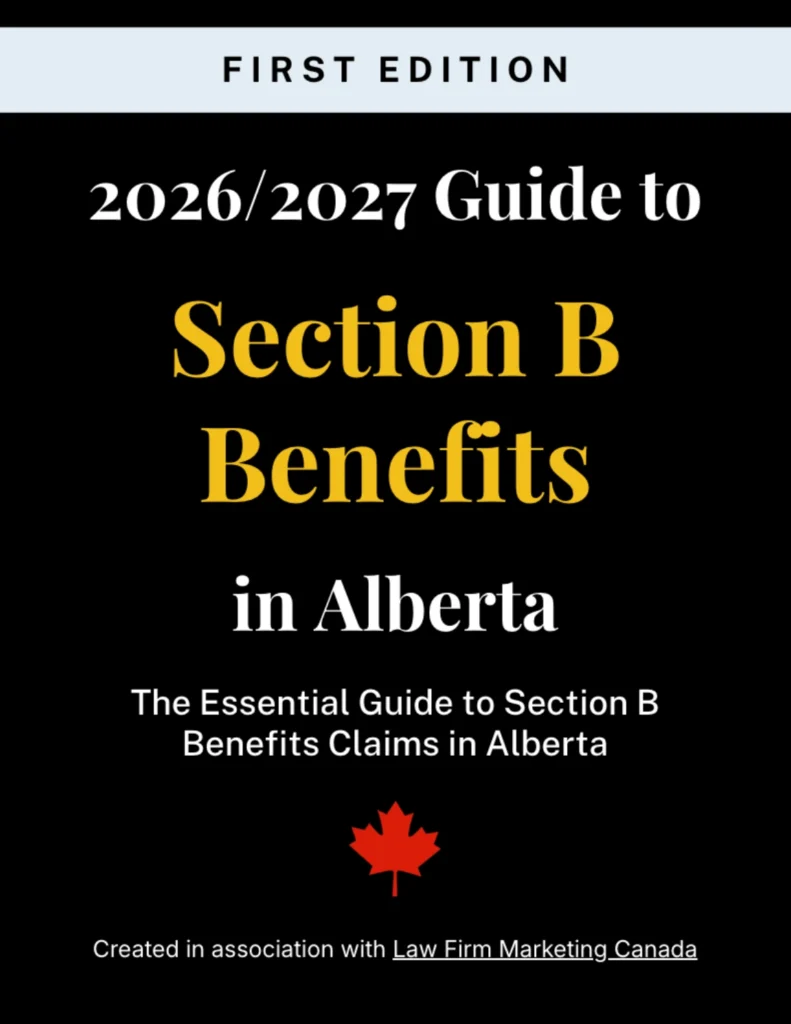
Download Our "A Guide to Section B Benefits in Alberta" E-Book
Here’s an e-book you might find useful if you’re interested in learning more about how section B benefits claims work.
What You Will Learn in This Free Resource
Our comprehensive digital guide provides clear, practical information to help you access the benefits you are owed without delay. Inside the e-book, you will find:
- Covered Medical and Rehabilitation Services: A complete breakdown of covered treatments, including physiotherapy, chiropractic care, psychological counselling, prescription drugs, and medical equipment under the Diagnostic and Treatment Protocols Regulation.
- Weekly Income Replacement Provisions: How disability benefits function if your injuries prevent you from working, including eligibility criteria, weekly payment caps, and duration limits.
- Essential Filing Deadlines: Step-by-step guidance on completing Notice of Claim forms (Form AB-1) and medical reports (Form AB-2) within strict statutory timelines set by the Insurance Act (Alberta).
- Section B Benefits vs. Tort Claims: How primary accident benefits work alongside a third-party claim against an at-fault driver for full losses under the Contributory Negligence Act.
- Common Insurer Disputes and Denials: What actions to take if your insurance carrier terminates your benefits, orders an independent medical exam, or claims your recovery period has ended.
Commonly Asked long-term disability Questions
Here are our most asked questions on long-term disability claims.
What is long-term disability?
Long-term disability claims arise when you have disability insurance, either through your work or privately, that denies your claim after you have become disabled.
Is there a time limit on when I can sue for long-term disability?
Yes. The Insurance Act, RSA 2000, sets a two-year limitation period that commences two years after the claims arise.
How much is my long-term disability case worth?
Long-term disability cases are several heads of damage that are assessed independently. First, there is the arrears or the past benefits that have not been paid. Next, there are potential future benefits. Finally, if a denial was made in bad faith, there may be extracontractual damages that can include aggravated damages or even punitive damages against the insurance company.
What types of compensation can I claim in a long-term disability case?
You can claim contractual damages for past benefits that should have been paid. In a settlement discussion, you can claim for future benefits that will be paid, but in a trial, you cannot make this claim. Finally, if the denial was in bad faith, you can make an extracontractual claim for aggravated damages and/or punitive damages.
What are the common causes of disability?
The most common causes of disability are related to chronic pain and psychiatric disorders like anxiety or depression. However, there are many causes of disability, including:
- Chronic pain;
- Depression;
- Anxiety;
- Brain injury;
- Stroke;
- Heart attack;
- Cancer;
- Injury;
- COVID;
- Stroke;
- Orthopaedic injury;
- Paralysis;
- And more.
What are my options if my long-term disability claim is denied?
The insurance company will provide you with options to appeal their decision. Keep in mind these appeal processes are usually created by the insurance company and adjudicated by the insurance company. And they do not stop the limitation period from running. Our lawyers will file a lawsuit instead and put the claim into the impartial realm of the court system.
What information is needed to support a long-term disability claim?
Copies of your policy, the denial letter, and your medical records are generally needed to support your long-term disability claim. Our lawyers can work with you to determine what documents exist and how to collect them to make sure nothing is missing.
When should a long-term disability lawyer be contacted?
If you have been denied long-term disability benefits, it is time to contact a lawyer to discuss next steps. Our consultations are always free, and there is no obligation to sign up.
Can a mental illness be considered a long-term disability?
Yes. Mental illness is increasingly being recognized as a real and problematic cause of disability for a substantial percentage of the population. In addition, these ailments are often invisible. Because of that, insurance companies will suggest that you have not met your burden to prove your mental illness exists and is disabling to deny your claim.
How is the Canada Pension Plan Disability different than a long-term disability?
The long-term disability claims we handle are from private long-term disability companies. Canada Pension Plan Disability is a statutory pension plan run by the Federal Government that you may or may not qualify for depending on your contributions to CPP and your injuries.
How is short-term disability different than long-term disability?
Short-term disability is similar to long-term disability but has a shorter waiting period to kick in and a shorter duration. Sometimes, the insurer or entity that pays short-term disability is different than the insurer that pays long-term disability. Since it is a different benefit, there is often some difference in the compensation formula between the two.
Do pre-existing conditions impact long-term disability claims?
Sometimes yes. Long-term disability contracts are often set up to have an exclusion for pre-existing conditions. These exclusion clauses typically only apply if you become disabled within the first year of coverage on most group policies. However, it is very important to read the specific language of your insurance policy if you have become disabled from a long-standing or pre-existing ailment.
FIGHTING FOR LTD BENEFITS IN SPRUCE GROVE?
Book Your FREE Consultation
We stand up to insurance companies
We’ll review your case and explain your legal options when it comes to appealing a denial or termination of your benefits.